Demand for Generative AI Talent Continues to Grow Across the UK
While the wider hiring market remains cautious, Generative AI is telling a very different story. Across the UK, businesses continue to invest in Generative AI recruitment, even as overall vacancy volumes soften.
While the wider hiring market remains cautious, Generative AI is telling a very different story. Across the UK, businesses continue to invest in Generative AI recruitment, even as overall vacancy volumes soften.
For many organisations, this is not a contradiction. It is a strategic response to changing economic conditions, rising costs and increasing pressure to do more with less.
In Q3, Generative AI jobs have emerged as a clear priority within IT recruitment and software recruitment, signalling where employers believe long-term value will be created.
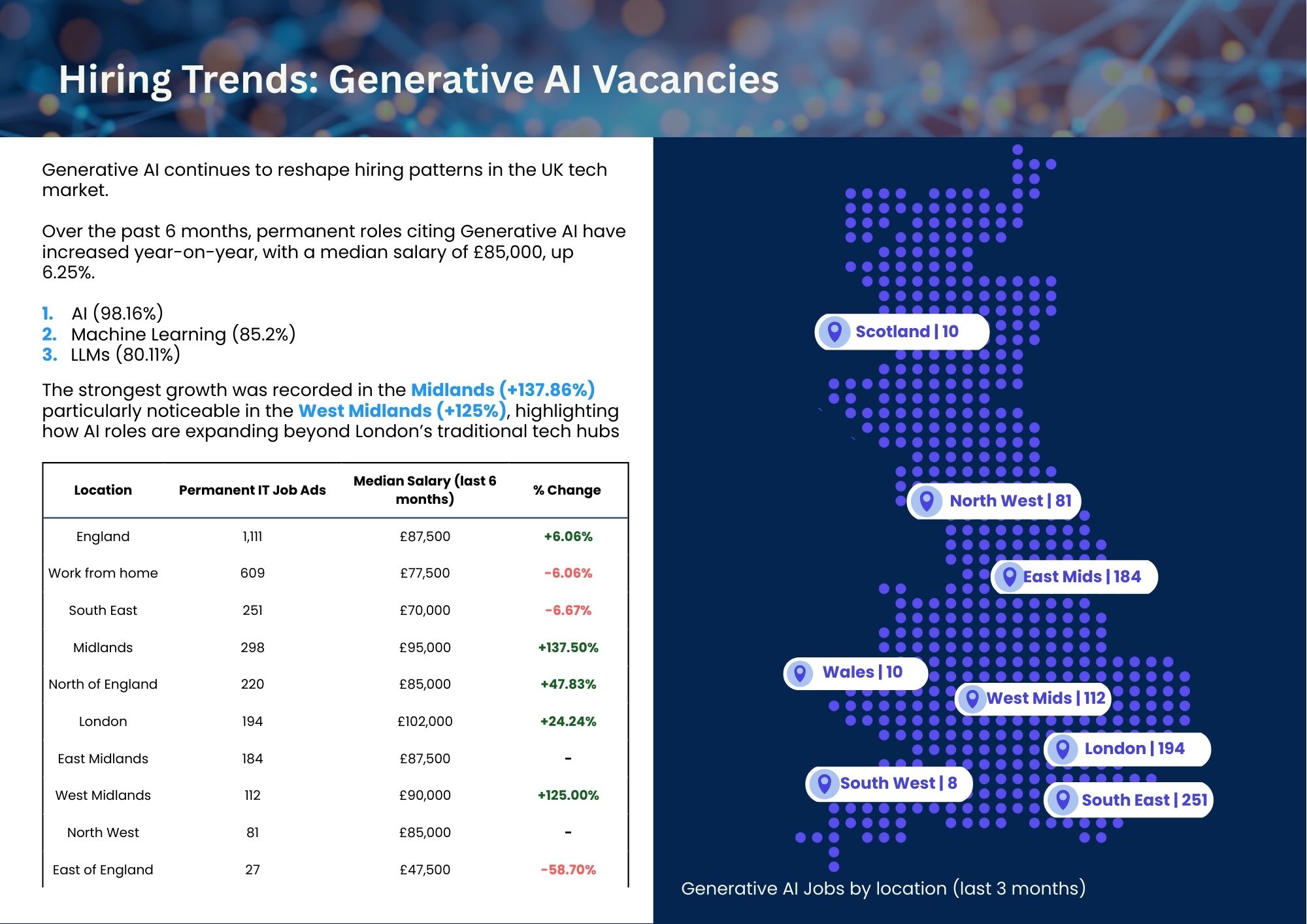
Vacancy volumes across the UK are down year-on-year, yet roles referencing Generative AI continue to increase. This growth is no longer limited to London or traditional technology hubs.
The strongest year-on-year increases in Generative AI jobs have been seen in the Midlands (+137.86%), with particularly strong momentum in the West Midlands (+125%).
This reflects a wider shift in how organisations across the UK are adopting AI technology, not just in London. Generative AI is moving beyond innovation teams and into everyday business functions, driving demand for skilled professionals who can implement, scale and govern AI solutions.
For employers, recruiting candidates with generative AI skills is about practical impact. It supports automation, improves decision-making and enables organisations to increase productivity without expanding headcount at the same rate.
Digital transformation remains at the top of the agenda for UK employers. 60% of organisations believe that improving digital access will transform their business more than any other trend. Generative AI sits at the centre of this shift.
From software development and data analysis to customer experience and internal operations, AI trends are directly influencing hiring decisions. Businesses are seeking professionals who can bridge the gap between technology and commercial outcomes, which is why AI jobs remain resilient even in a slower market.
For IT recruiters and software recruiters, this has created a clear focus on sourcing candidates who can demonstrate real-world AI application, not just theoretical knowledge.
On the surface, the rise of one-click applications and AI-powered job search tools suggests hiring should be easier. In reality, the opposite is true.
Application volumes for IT jobs and AI jobs are rising rapidly, but the supply of experienced Generative AI professionals remains limited. Skills shortages across AI, data and cybersecurity continue to shape the market, increasing competition for top talent.
As a result, time to hire has increased to as much as 56 days, compared to 35 days at the same point last year. Hiring managers are reviewing significantly more applications per role, making it harder to identify the right candidates quickly and confidently.
This is particularly important when 85% of HR decision-makers admit their organisation has made a bad hire. In specialist AI roles, the cost of getting it wrong can be significant.
Investment
Across all permanent IT vacancies in the UK, the median salary now sits at £51,000, representing a 15 percent year-on-year decrease. While this reflects broader market pressure, it has not reduced demand for high-quality Generative AI talent.
Instead, employers are becoming more selective. They are prioritising candidates with proven experience, strong communication skills and the ability to translate AI capability into measurable business value. This has reinforced the importance of working with an experienced IT recruiter or software recruiter who understands the nuances of the Generative AI market.
The continued growth in Generative AI recruitment highlights a clear shift in hiring priorities. Even in a cautious market, organisations are investing in skills that will define their future competitiveness.
For employers, success will depend on clarity of role design, realistic expectations and access to specialist recruitment expertise. For candidates, Generative AI jobs offer some of the strongest long-term opportunities within IT and software recruitment in the UK.
As AI trends continue to shape the workforce, Generative AI is no longer a niche. It is becoming a core pillar of modern hiring strategies.