What’s the Most Common Reason Candidates Decline a Job Offer at the Final Stage?
What’s the Most Common Reason Candidates Decline a Job Offer at the Final Stage?
Reaching the final stage of a recruitment process only to have a candidate decline the offer is one of the most frustrating, and costly outcomes for employers.
Time has been invested by hiring managers, HR teams and interview panels, only for the process to fall apart at the last hurdle.
To better understand why this happens, we recently ran a survey asking candidates one simple question:
“What’s the most common reason you would decline a job offer at the final stage?”
The results highlight some clear and avoidable themes.
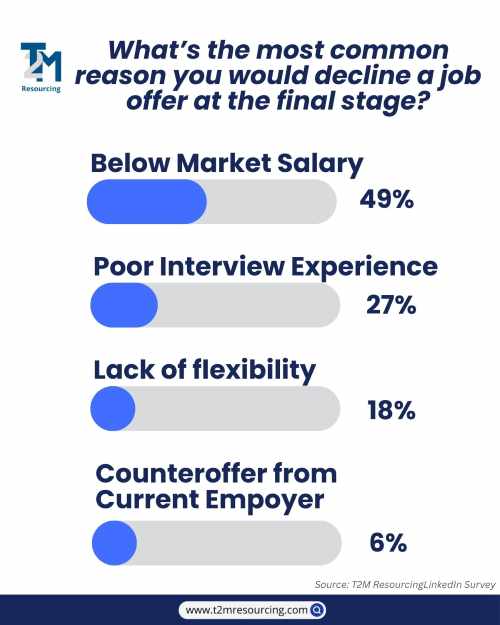
Nearly half of all candidates said they would walk away at the final stage due to salary alone.
But the data also shows that non-financial factors account for almost half of all declined offers.
Let’s break down what this means for employers.
Salary remains the number one reason candidates decline offers, and by a significant margin.
In many cases, this isn’t about unrealistic expectations. It’s often due to:
- Roles being benchmarked against outdated salary data
- Budgets being approved before market conditions shift
- Salary expectations not being fully aligned early in the process
By the final stage, candidates should:
- Have a strong understanding of their market value
- Are comparing multiple opportunities
- Expect transparency and realism
While salary is the headline figure, many candidates make decisions based on the overall package.
Often, full details of benefits such as pension contributions, health cover, insurances, study support and realistic bonus expectations only become clear at the final stage of a recruitment process. When this information isn’t transparent early on, candidates may feel the offer doesn’t reflect their true market value, even if the base salary appears competitive.
Key takeaway for employers:
If package expectations aren’t aligned upfront, the risk of losing a candidate at offer stage is extremely high – and this doesn’t just go for salary.
More than one in four candidates said they would decline an offer due to a poor interview experience, regardless of salary.
Common issues include:
- Disorganised interview processes
- Interviewers being unprepared
- Poor communication or long delays
- A lack of clarity about the role or progression
Candidates often view the interview process as a preview of company culture. A negative experience raises red flags about leadership, workload and internal communication.
One of the biggest challenges we see in today’s market is the time lag between application and offer.
Candidates experience extended gaps between first and second interviews, sometimes followed by additional stages, and further delays while internal approvals and offer sign-off are secured.
For high-potential talent, these delays can quickly erode interest. Without a well-planned and timely recruitment process, employers risk losing strong candidates to organisations that move faster and deliver a more engaging interview experience.
Key takeaway for employers:
Your interview process is not just an assessment tool, it’s a sales process.
Flexible working remains a critical decision factor.
Nearly one in five candidates cited a lack of flexibility as their reason for declining an offer.
This includes:
- Rigid office attendance policies
- Lack of hybrid or remote options
- Inflexible working hours
Even when salaries are competitive, inflexibility can be a dealbreaker, particularly for experienced professionals and senior candidates.
Key takeaway for employers:
Flexibility is no longer a “nice to have”, it’s a core part of your value proposition.

Contrary to popular belief, counteroffers were the least common reason for declining an offer.
This suggests that:
- Many candidates are emotionally ready to leave
- Counteroffers alone are often not enough
- Other factors (salary, flexibility, culture) matter more
Key takeaway for employers:
Losing candidates to counteroffers is less about money and more about failing to address their motivations earlier.
The survey results point to one clear conclusion: Most declined offers are preventable.
To reduce offer drop-outs, employers should:
- Benchmark salaries accurately and regularly
- Align expectations early in the recruitment process
- Deliver a structured, engaging interview experience
- Be clear and competitive on flexibility
- Communicate consistently and transparently
Working with a specialist recruitment partner can help manage these risks by:
- Setting realistic salary expectations
- Managing candidate engagement
- Providing honest market feedback
Declined offers aren’t just frustrating, they’re expensive.
Understanding why candidates walk away at the final stage gives employers the opportunity to fix issues before they become dealbreakers.
In today’s market, getting to offer stage isn’t enough.
Winning the candidate is what matters.